

Last updated October 30, 2026
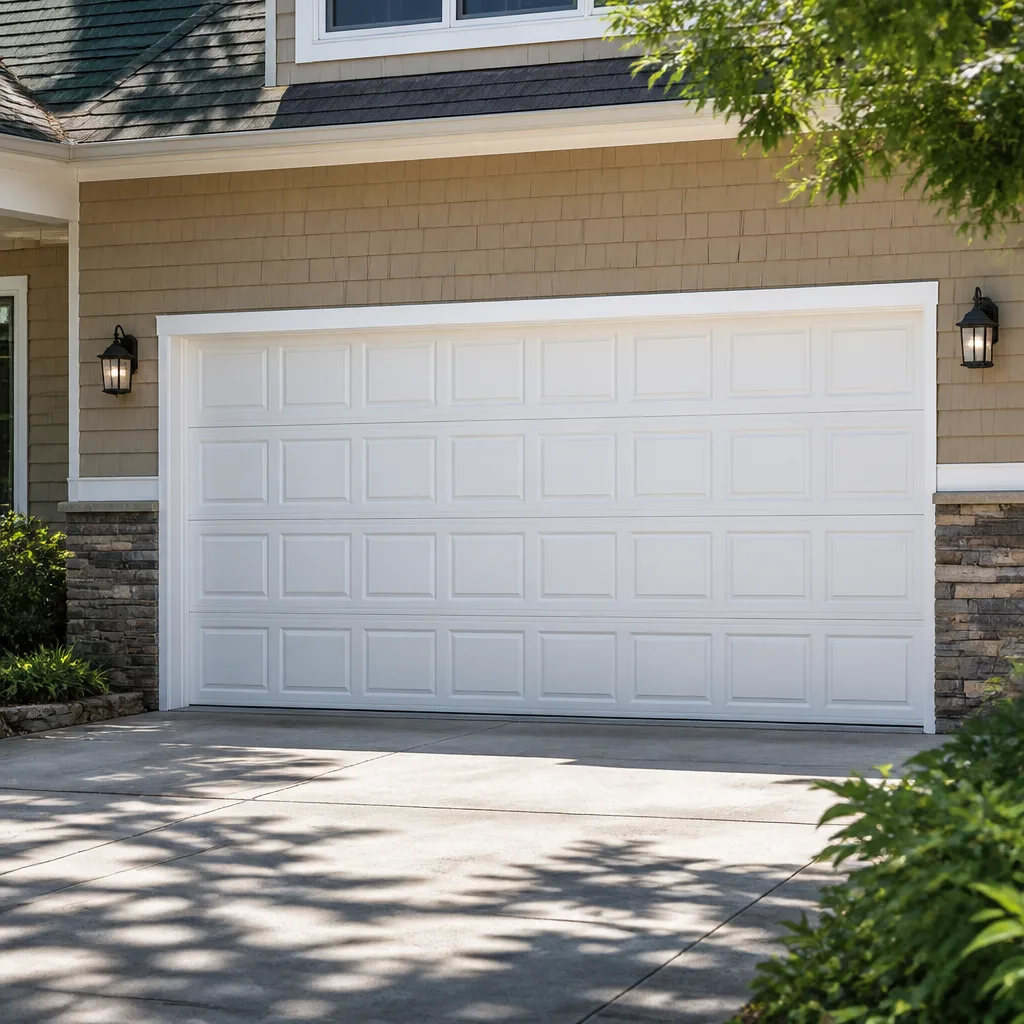 Raised-panel steel
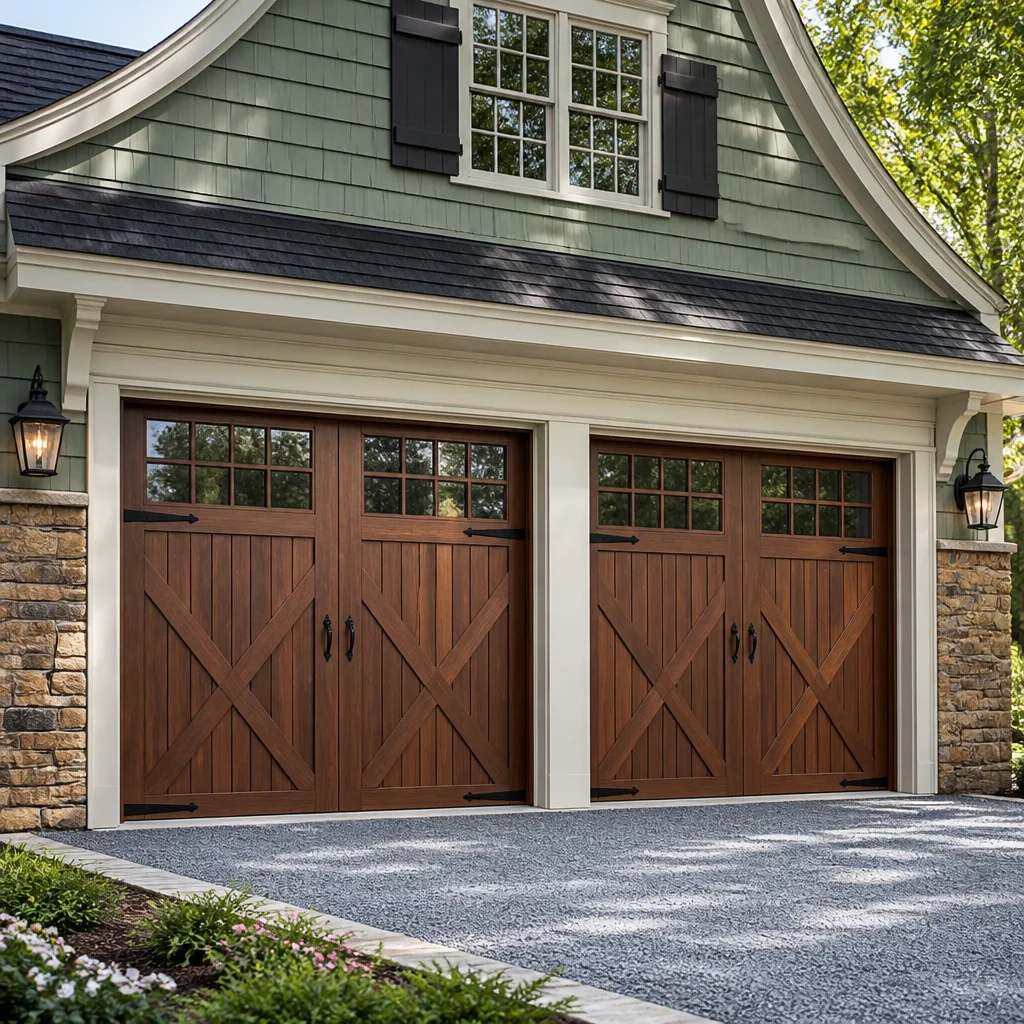 Carriage house
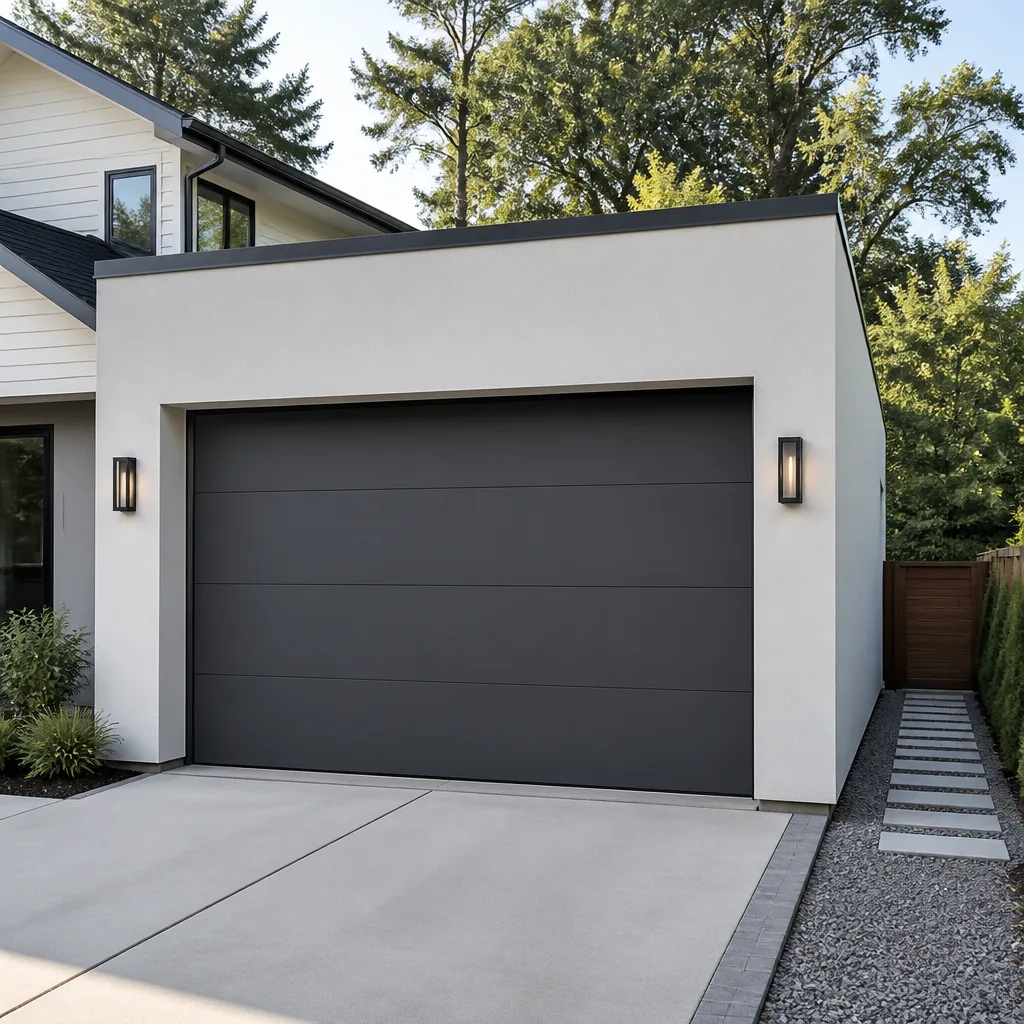 Modern flush
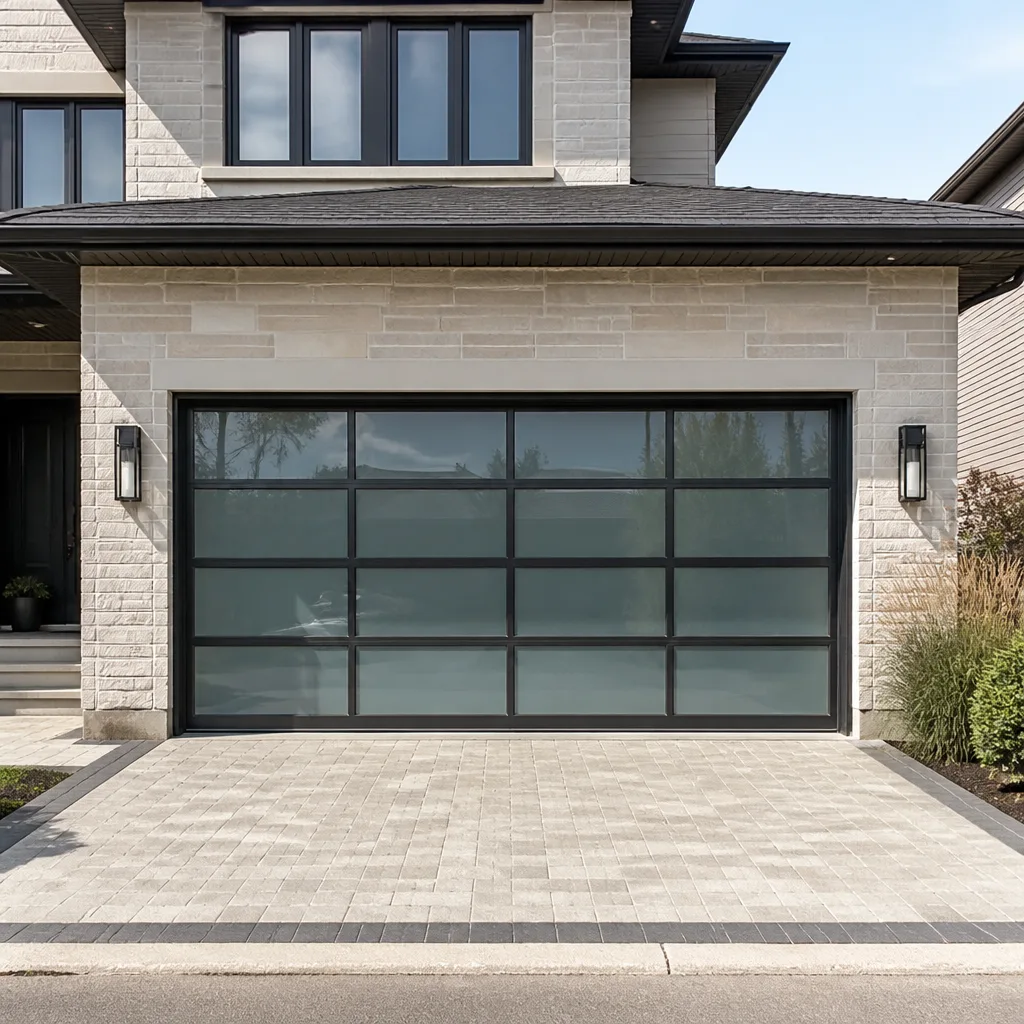 Full-view glass
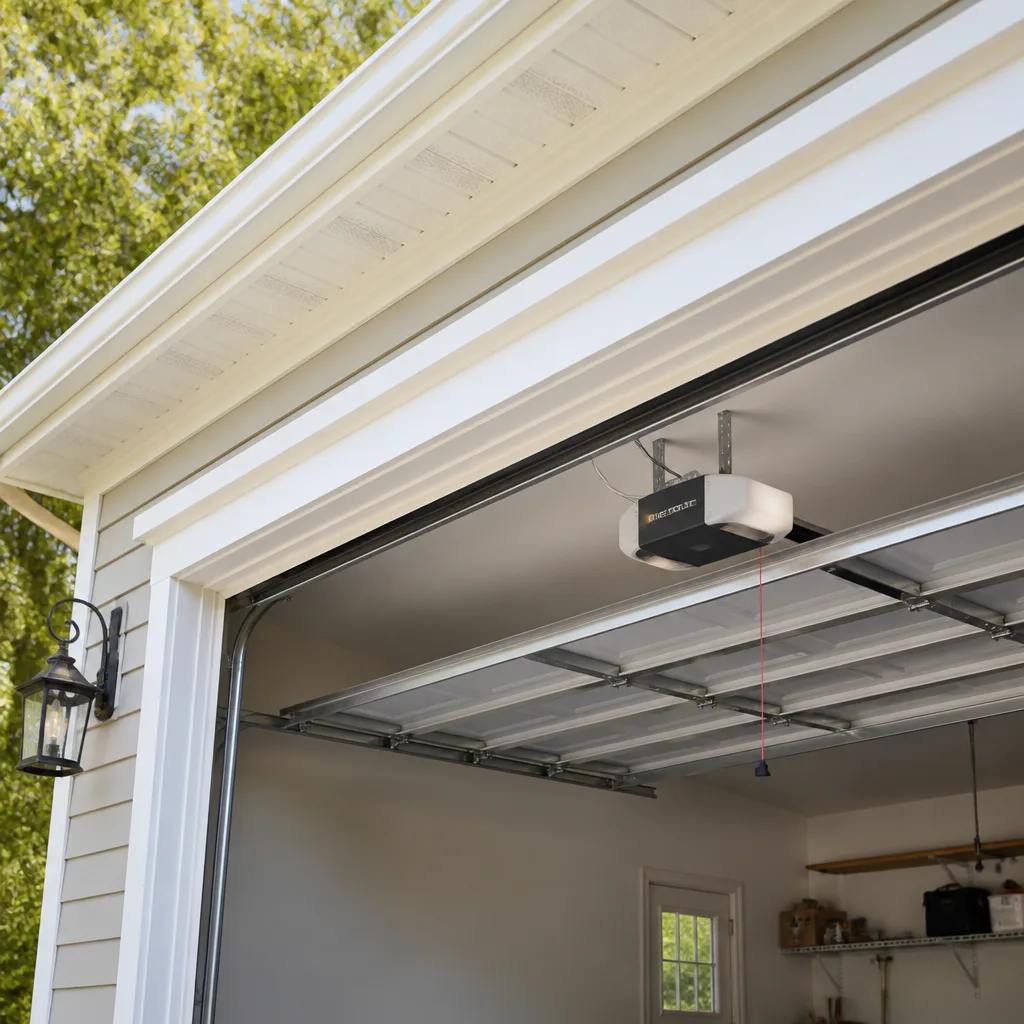 LiftMaster openers
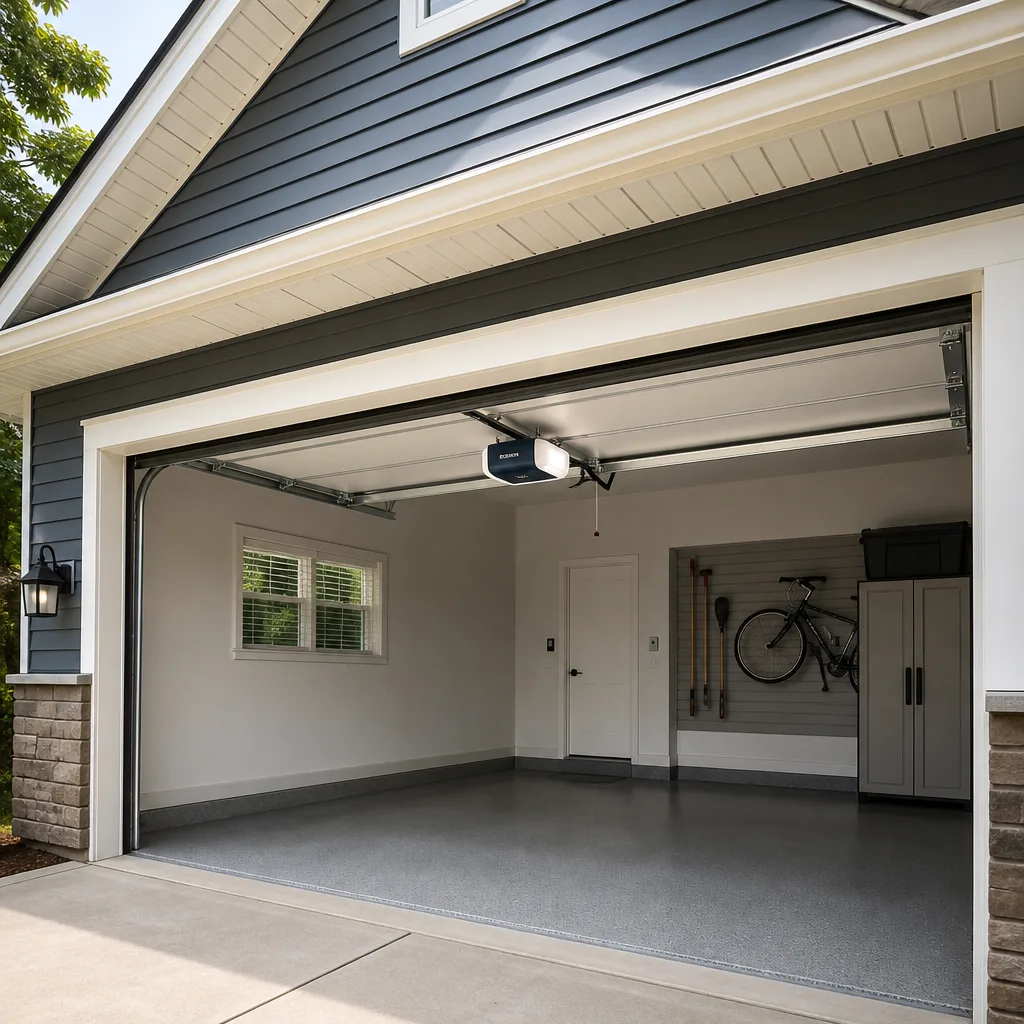 Chamberlain openers
Full 25-point door and opener safety check with every visit - springs, cables, rollers, tracks, and your LiftMaster or Chamberlain opener included
You get a price before we start. It does not change when the truck arrives.
Get your free estimateThe Complete Garage Door Repair Guide for Elk Grove Homeowners
The Central Valley sun hits an exposed metal torsion spring differently than it does in coastal California. In Elk Grove, the combination of 100°F-plus summer days, cool delta nights, and fine agricultural dust means the hardware that lifts your door four times a day is working under conditions most manufacturer estimates never accounted for. UV degradation and thermal cycling shorten spring life by 20 to 30 percent compared to the lifespan printed in manuals written for moderate climates. This guide is built for the specific housing stock, weather patterns, and repair realities of Elk Grove – from older Laguna Creek tracts to newer Stonelake builds. If you’re looking for garage door repair in Elk Grove that accounts for those local conditions, we’ll walk you through what actually breaks, what it costs, and what you can fix yourself.
Quick Answer
Garage door repair in Elk Grove most commonly involves broken torsion springs, worn rollers, misaligned tracks, snap-failed cables, and opener circuit boards that overheat in valley summers. The average repair call runs between $180 and $450 depending on the part and brand. If your door won’t open, makes a grinding noise, or sits crooked in the frame, you’re dealing with one of about five predictable failures. Most can be diagnosed in under 30 minutes by a specialist, and about half are safe to inspect yourself before calling for service.
Styles & brands we work with
Table of Contents
- How Elk Grove’s Climate Breaks Garage Doors Faster
- Reading the Hardware in Your Neighborhood’s Homes
- What a Homeowner Can Safely Fix
- What Should Only Be Handled by a Trained Specialist
- Repairing by Brand: What Your Opener and Door Tell You
- What Garage Door Repair Costs in Elk Grove
- Permits, Codes, and the City of Elk Grove
- A Seasonal Maintenance Calendar for Elk Grove’s Two-Season Climate
How Elk Grove’s Climate Breaks Garage Doors Faster
Garage door systems are designed to a national average that doesn’t exist in Elk Grove. The manufacturer’s spring-life estimate of 10,000 cycles assumes moderate temperatures and clean air. Here’s what actually happens in our valley climate.
Spring fatigue from thermal cycling. Garage door torsion springs are wound steel under constant tension. When summer days push your garage interior past 110°F and nights drop into the 60s, that steel expands and contracts every 24 hours. Each cycle is microscopic. Multiplied across hundreds of valley summer days, the spring develops metal fatigue that leads to sudden failure – usually with a loud crack that homeowners describe as “a gunshot from the garage.” In our experience, springs in Elk Grove garage doors fail 20 to 30 percent earlier than the same spring would in San Francisco or Sacramento’s coastal-adjacent neighborhoods.
Weatherstripping destroyed by UV and heat. The rubber and vinyl components on your door take the brunt of Elk Grove’s sun exposure. Bottom seals on west-facing doors in neighborhoods like Sheldon Road corridor and parts of Laguna deteriorate visibly within two summers. Once the bottom seal cracks or flattens, three things happen: dust from the open fields gets in, your utility bill rises as conditioned air leaks, and rodents find a gap. The fix costs less than $40 for the material, and it’s one of the safest repairs for a homeowner to do.
Opener circuit boards cooking in the heat. Garage door openers store their logic boards and capacitors in a plastic housing mounted near the ceiling, where heat pools. In Elk Grove’s 100°F-plus stretches, the interior of an uninsulated garage can reach 130°F to 140°F. The capacitors on older 1990s-era Chamberlain and Genie openers are particularly vulnerable. When a capacitor degrades, the opener behaves erratically: the door goes up but not down, the remote works intermittently, or the motor hums but the chain doesn’t move. Blaming the remote or the wall button is usually wrong; it’s the heat-degraded board.
Dust and agricultural particulates. Elk Grove sits at the edge of active farmland. Fine dust settles into roller tracks, hinge pins, and the opener’s gear assembly. Combined with grease, it becomes a gritty paste that accelerates roller and hinge wear. A door that squeaks isn’t just annoying – it’s a sign that lubricant has been displaced by that paste, and the metal parts are now wearing against each other.
Here’s what a practical inspection cadence looks like for an Elk Grove homeowner:
- Every spring (April): Check weatherstripping at the bottom and sides. Replace if cracked, flattened, or if you can see daylight from inside the closed garage.
- Every autumn (October): Inspect roller condition and listen for grinding during a full open-close cycle. Clean tracks with a dry cloth.
- Every summer month (June through September): Listen for opener motor strain. If the opener sounds like it’s working harder than it did in spring, the heat may be degrading capacitor performance – have it checked before it fails.
- After any windstorm: Check track alignment. Valley wind gusts press against the door and can throw a track out of true.
For a full breakdown of what a repair visit involves, see our page on Garage Door Repair in Elk Grove.
Reading the Hardware in Your Neighborhood’s Homes
Elk Grove isn’t one housing market – it’s three or four distinct building eras, each with its own garage door and opener generation. Knowing what you likely have helps you understand what will fail first and what parts a repair technician will need to carry.
Lakeside and Old Town Elk Grove (pre-1990 homes). These older properties often have original one-piece doors or early sectional doors with extension spring systems. If your garage has two long springs running parallel to the horizontal track, that’s an extension spring system – common before torsion springs became standard. Extension springs fail by stretching out, losing their lifting force gradually. The door feels heavy and requires manual lifting. These systems also predate the safety cable requirements now built into code, which makes a DIY repair more dangerous than the part cost would suggest.
Laguna and Sheldon Road corridor (1990s to 2000s builds). This era shipped with sectional doors, typically 16×7 steel, and torsion springs rated for standard residential use. The openers in these homes are the first generation of belt and chain-drive models from LiftMaster and Chamberlain – and those units are now at or past their 15 to 20 year service life. The boards and the drive gears are the weak points, not the motor itself. Expect a failure pattern of a working motor that won’t move the door, followed by a stripped plastic gear replacement or a logic board replacement.
Stonelake, Madeira, and newer Laguna Ridge (2010s to present). Newer construction typically has lighter-weight doors with polyurethane insulation and higher-cycle torsion spring systems. The openers tend to be Wi-Fi-connected Chamberlain and LiftMaster models with DC motors. Common failure points shift: fewer spring breaks early on, but more logic board and sensor issues. Builders also aggressively grade lots in new developments, so slab settlement in the garage – especially where the concrete meets the driveway apron – throws door alignment off within the first five years.
Here’s a quick at-a-glance guide:
- Pre-1990 home in Old Town or Lakeside: Expect extension springs, older track hardware. Have a professional check for missing safety cables before any work.
- 1990s-2000s Laguna or Sheldon area home: Expect torsion springs at end-of-life, worn rollers, and opener gears near failure. Highest concentration of repeat service calls in Elk Grove.
- 2010s+ Stonelake or Laguna Ridge home: Expect sensor misalignment from slab movement and Wi-Fi connectivity issues. Springs are generally mid-life, but not immune to valley heat cycling.
When a technician walks into a garage, the first question isn’t normally “what broke?” – it’s “what brand and generation am I looking at?” That’s why our team is trained on products from LiftMaster, Chamberlain, Genie, Clopay, and the other major residential brands. We work on your brand, whatever it is. If you need a complete replacement rather than a repair, our Garage Door Installation in Elk Grove page covers the process end to end.
What a Homeowner Can Safely Fix
There’s a line between maintenance you can do with basic tools and repairs that can send you to the emergency room. We’re going to draw that line clearly, without condescension. You don’t need a specialist for everything, and paying for a service call you could have avoided stings.
Safe DIY task 1: Replacing the bottom weatherstripping. This is the highest-value maintenance task in Elk Grove and also the easiest. You’ll need a new seal of the correct width (measure the groove, usually 3/16 inch or 1/4 inch T-channel), a flathead screwdriver, and silicone lubricant. Slide the old seal out from one end, feed the new one through the channel, and trim to length. Twenty minutes of work at most, and you’ve sealed out the dust and heat.
Safe DIY task 2: Aligning photo-eye safety sensors. The sensors at the bottom of each track can get nudged by brooms, bikes, or moving boxes. If your door starts down and immediately reverses, check whether both sensor lights are solid. A blinking light means misalignment. Loosen the wing nut, adjust the sensor until the light goes solid, tighten, and test. This problem is almost never an electrical failure.
Safe DIY task 3: Lubricating rollers, hinges, and the torsion spring. Use a lithium-based white grease or a silicone lubricant – never WD-40, which displaces the heavier lubricant and leaves parts dry. Apply a small amount to the metal roller stems, the hinge pins, and along the torsion spring coil. This reduces friction and extends roller life. Do this twice a year in Elk Grove, before summer and before winter rains, since our dust accelerates lubricant degradation.
Safe DIY task 4: Clearing track obstructions and tightening loose hardware. Over time, the bolts that hold the vertical and horizontal tracks to the wall work loose. A 7/16 inch socket on each bracket bolt, tightened snug but not over-torqued, prevents the track from drifting and throwing the door out of plumb. Also check that no cobwebs or debris have accumulated inside the track itself.
Each of these tasks takes under an hour with tools most Elk Grove homeowners already have. They prevent the kind of failures that turn into $400 emergency calls.
One caution before moving on. The photo-eye sensors connect to low-voltage wiring, which is safe to handle. But the opener itself plugs into 120-volt power. Before doing any work near the opener’s motor housing – even just cleaning – unplug it. The door’s emergency release cord is also not a repair tool; it’s for getting your car out during a power outage. Don’t pull it and then try to move the door manually while the spring is broken – that’s a guaranteed injury.
What Should Only Be Handled by a Trained Specialist
Some garage door failures involve stored kinetic energy measured in hundreds of pounds. This isn’t a warning about stubborness; it’s about physics. The following repairs carry genuine injury risk, and we recommend calling a trained professional rather than attempting a DIY fix.
Torsion spring replacement. A torsion spring wound on the header above your door stores enough energy to lift the full weight of a 150 to 300 pound door. When it snaps, it releases that energy instantly – which is why the failure sounds like a firecracker. Replacing one means winding the new spring under tension using steel winding bars. If a bar slips or the wrong bar is used, the spring unwinds violently. Orthopedic surgeons treat these injuries regularly. Do not attempt this repair. Call a professional.
Extension spring replacement (especially pre-1990 systems). Older Elk Grove homes with extension springs carry an additional risk: many of these systems predate safety cable codes, meaning the spring can fly across the garage when it breaks rather than being contained. If you have a broken extension spring without a through-cable, the correct role for a homeowner is to leave the door closed, keep clear of the spring’s line of travel, and call for service.
Cable replacement and re-spooling. The lift cables run under tension from the bottom brackets to the drum at the top of each track. A snap-failed cable whips back with force. Replacing one involves transferring door weight between the cable and the spring system – a moment where the door can drop unexpectedly. This is not a two-wrench job.
Track re-alignment after a hard hit. If the door jumped the track or a vehicle bumped the bottom panel, the track itself may be bent or the wall brackets may have pulled loose. While minor track cleaning is safe, straightening a bent track or re-securing a track with the door off its rollers requires the door to be lifted and supported safely. Without the right equipment, the door can fall.
Opener logic board or motor replacement on 1990s units. The capacitors inside an opener store electrical charge even after the unit is unplugged. Touching the wrong component inside the motor housing can shock you. If the opener is over 15 years old and the motor or board has failed, replacement is usually the better call anyway – and that’s a job for a brand-trained technician.
Our rule of thumb at Artisan Garage Door Repair is simple: if the repair involves a part under spring tension or a cable carrying the door’s weight, it belongs with a specialist. Garage doors are all we do, which means we’ve developed the muscle memory for these jobs that a general handyman hasn’t. If you’re unsure whether something is safe to touch, call us at (855) 631-8980 and describe what you’re seeing. We’ll tell you honestly whether it needs a visit.
If your opener is the issue rather than the door hardware itself, our Garage Door Opener Repair in Elk Grove page goes deeper into what fails and what it costs to fix.
Repairing by Brand: What Your Opener and Door Tell You
Diagnosis starts before you touch the door, because each brand has a signature set of failure points. When we roll up to an Elk Grove home, the brand on the opener or the door panel tells us what to look for first.
LiftMaster (and its Chamberlain sibling). These two brands are manufactured by the same parent company, and they dominate the Elk Grove market across all housing eras. Older belt and chain-drive units from the 1990s and 2000s have a known weak point: the plastic drive gear on the top of the motor shaft. When it strips – usually in the summer heat – the motor runs but the door doesn’t move. The repair is straightforward for a technician with the part on the truck. Newer LiftMaster units with DC motors are more reliable mechanically but have more complex logic boards. The error is often diagnosed wrong by a non-specialist, who blames the wall button or the remote first.
Genie. Genie is the most common opener brand in older Elk Grove homes, particularly in the Lakeside and Old Town areas. Genie’s chain-drive openers of the 1990s are workhorses on the mechanical side, but their logic boards degrade in the heat. A Genie that opens but won’t close, or whose remotes suddenly stop working together, is usually suffering board failure. The good news: Genie openers accept universal remotes easily, and many of the boards are repairable without full replacement.
Clopay (the door brand). Clopay doors are common in mid-2000s Elk Grove construction, particularly in Stone Lake and the Sheldon Road corridor. Clopay’s steel sandwich doors are structurally sound, but their bottom bracket and cable anchor points are less forgiving than Amarr or Wayne Dalton when a cable snaps under load. If you have a Clopay door and hear cable noise, get it looked at sooner rather than later – a bracket that tears loose does more damage than the cable itself.
What brand fluency means for you. A one-brand shop sees a Genie opener and wants to sell you a LiftMaster replacement, because that’s what they stock. A general handyman sees the same opener and guesses. We’re trained across eight major garage door and opener brands – including LiftMaster, Chamberlain, Genie, Clopay, Amarr, Wayne Dalton, Craftsman, and Raynor – which means the recommendation you get is about the condition of your door, not our inventory. Diagnosed right the first time is the standard, not the exception. If a repair isn’t worth doing on a heavily worn door, we’ll tell you that too.
What Garage Door Repair Costs in Elk Grove
Cost is the second question after “can you fix it?” Here’s what we consistently see in the Elk Grove market.
Garage door repair in Elk Grove typically costs $180 to $450 for the most common failures, with spring replacement at the higher end and minor part fixes at the lower end. These are real market ranges from a specialist service, not the lowball “tune-up special” prices that turn into upcharges once a technician is in the driveway.
| Repair Type | Typical Elk Grove Price Range | Notes |
|---|---|---|
| Torsion spring replacement (single) | $180 – $340 | Price varies by spring size and cycle rating. Two-spring systems are higher. |
| Extension spring replacement (pair) | $150 – $280 | Common on pre-1990s homes in Old Town and Lakeside. |
| Roller replacement (set of 10-12) | $120 – $220 | Nylon rollers quiet the door significantly. |
| Cable replacement (single side) | $130 – $220 | Often quoted together with a spring job since they fail together. |
| Opener logic board replacement | $160 – $320 | Depends on opener brand and board generation. |
| Photo-eye sensor replacement/alignment | $80 – $150 | Alignment alone is often a service-call minimum. |
| Bottom weatherstripping (full 16-ft door) | $75 – $130 | DIY for around $40. |
| Full opener replacement (installed) | $350 – $650 | Depends on drive type, features, and brand. |
What the table doesn’t tell you is that the final price depends on what brand and generation you have. A 1990s extension-spring system has different parts and labor than a 2015 torsion-spring door. The best way to get an honest quote is to describe what you’re seeing – not to guess at what’s broken.
We quote the price before any work starts, and it’s the price you pay. If a technician discovers a second problem during the repair, we stop and call you with the updated number. No surprise invoices. In Elk Grove, the service call fee to diagnose a door is typically $40 to $80, and credible shops apply that diagnostic fee toward the repair if you proceed. If a company won’t tell you the diagnostic fee before scheduling, call someone else.
For a deeper dive into pricing for specific failures, our Garage Door Repair in Elk Grove page has a full breakdown.
Permits, Codes, and the City of Elk Grove
Here’s a surprise most homeowners don’t see coming: the City of Elk Grove treats garage door work differently depending on whether it’s a repair or a structural replacement.
Mechanical repair does not require a city permit. If you’re replacing springs, cables, rollers, hinges, or an opener, you don’t need to involve the City. These are owner-authorized repairs to existing equipment. That’s the category nearly all service calls fall into.
Structural replacement can require a permit. The City of Elk Grove’s building division generally treats a complete door replacement – where the entire door, tracks, and mounting hardware are swapped out – as a minor structural alteration in some circumstances. The trigger point is usually whether the work disturbs the building’s fire rating (for attached garages) or changes the opening size. Door replacement on an attached garage with living space above it is more likely to require review than a detached garage door swap.
What you should do before a full replacement. If you’re planning a complete garage door installation in Elk Grove, call the City’s building department or have your installer check the permit requirements for your specific house. Most specialist installers in the area are familiar with the process and can tell you whether your job needs a permit before any work begins. Don’t rely on a handyman to know this – the city inspection, if one is triggered and missed, becomes your problem at resale.
The practical takeaway. For the repairs described in this guide – springs, cables, sensors, openers – you’re not dealing with permits. For a full door replacement, particularly on an older home in Elk Grove, confirm the requirement first. If you’re weighing repair against replacement, our Garage Door Installation in Elk Grove page covers the full replacement timeline and what to expect.
A Seasonal Maintenance Calendar for Elk Grove’s Two-Season Climate
Generic maintenance calendars say things like “check your door in the fall before winter.” Elk Grove doesn’t have winter – not in the way those guides mean. We have a long dry summer and a short wet winter, and the transition between them is when doors fail. Here’s the calendar we recommend for this specific valley climate.
April to May (pre-heat prep). Before the triple-digit weeks arrive, do the following:
- Lubricate all moving parts: rollers, hinges, torsion spring. This is the single highest-value maintenance task in Elk Grove.
- Replace brittle weatherstripping: materials degrade fastest in the first heat wave. Doing this in April means your door is sealed before the heat arrives.
- Test the opener’s force settings: run the door through a full open-close cycle and listen for strain. A door that struggles now will fail in July.
- Check the photo-eye sensors: alignment problems often appear after spring cleaning, when boxes and bikes have moved near the door.
June through September (heat survival). During the peak heat, two things matter:
- Listen for opener motor strain on hot afternoons. If the motor sounds labored at 4 p.m. but fine at 8 a.m., the heat is degrading capacitor performance. Don’t ignore it – the failure point is coming.
- Keep the garage interior from becoming an oven. The extreme heat shortens opener board life. If you have an uninsulated west-facing garage door in a Sheldon Road corridor home, consider insulating panels. The door hardware will thank you.
- Don’t open and close the door repeatedly as a “ventilation” strategy. Each cycle is a spring cycle. Multiple unnecessary open-close cycles in the heat accelerate spring fatigue.
October to November (pre-rain prep). The rains come, and with them, swollen wood – if your door’s frame or trim is wood. Do the following before the first heavy storm:
- Re-check the bottom seal. A seal that held during the dry summer may have cracked from UV exposure. You don’t want the first storm to reveal the gap via a wet garage floor.
- Check the track-to-wall brackets. Six months of heat expansion and contraction can loosen these bolts. Snug them up.
- Run the door and watch for wobble. Any wobble that wasn’t there in April indicates a worn roller or a loosened track. Address it now, before wet weather complicates the repair.
December through March (wet-season awareness). Elk Grove’s cool wet months don’t stress the door itself much, but they stress the wood trim and the connection between the garage slab and the door. Watch for:
- Water pooling at the bottom corners after a storm – a sign the bottom seal isn’t seating flush on settled concrete.
- Slower door movement in cold snaps; the lubricant thickens, but if the door is struggling more than normal on a 40° morning, a roller or hinge is binding.
- Rust on any exposed hardware. Coastal fog isn’t the issue here; it’s the condensation from temperature swings when the heater runs.
This calendar is specific to Elk Grove’s actual weather pattern, not a generic fall-and-spring schedule from a national blog. For a professional inspection, we service the entire Elk Grove area – from Old Town to Laguna Ridge. Get in touch through our Artisan Garage Door Repair home page.
Common Mistakes to Avoid
- Putting off spring replacement until it’s convenient. A broken torsion spring means the door is dead weight. Waiting a week means a week without your car, or worse – someone attempts to lift the door manually and gets hurt. When a spring snaps, call the same day.
- Using WD-40 on garage door parts. WD-40 is a solvent, not a lubricant. It strips away the grease that was protecting your rollers and hinges, leaving bare metal to wear against bare metal. Use lithium grease or silicone spray.
- Replacing the opener when the problem is a $30 sensor. A blinking photor-eye light is usually a 5-minute alignment fix, but we’ve seen homeowners quoted full opener replacements for exactly that problem. Ask the technician to show you the failure before you agree to a new unit.
- Ignoring a door that closes crooked. A door that sits unevenly in the frame is telling you something: a spring is weakening, a cable is fraying, or a track has drifted. The longer it runs out of true, the more the rollers and hinges self-destruct. It won’t fix itself.
- Buying a new opener without checking the existing door’s balance. In Elk Grove’s housing stock, a 15-year-old door and a 15-year-old opener typically wear out together. Installing a new opener on a door with failing springs means the new opener is doing double duty, and it will burn out early. Check the door first.
- Assuming a permit is always required for garage door replacement. As covered above, mechanical repairs need no permit, and even a full replacement only triggers permit review in specific structural circumstances. But don’t assume – verify with the City before the work.
See the difference
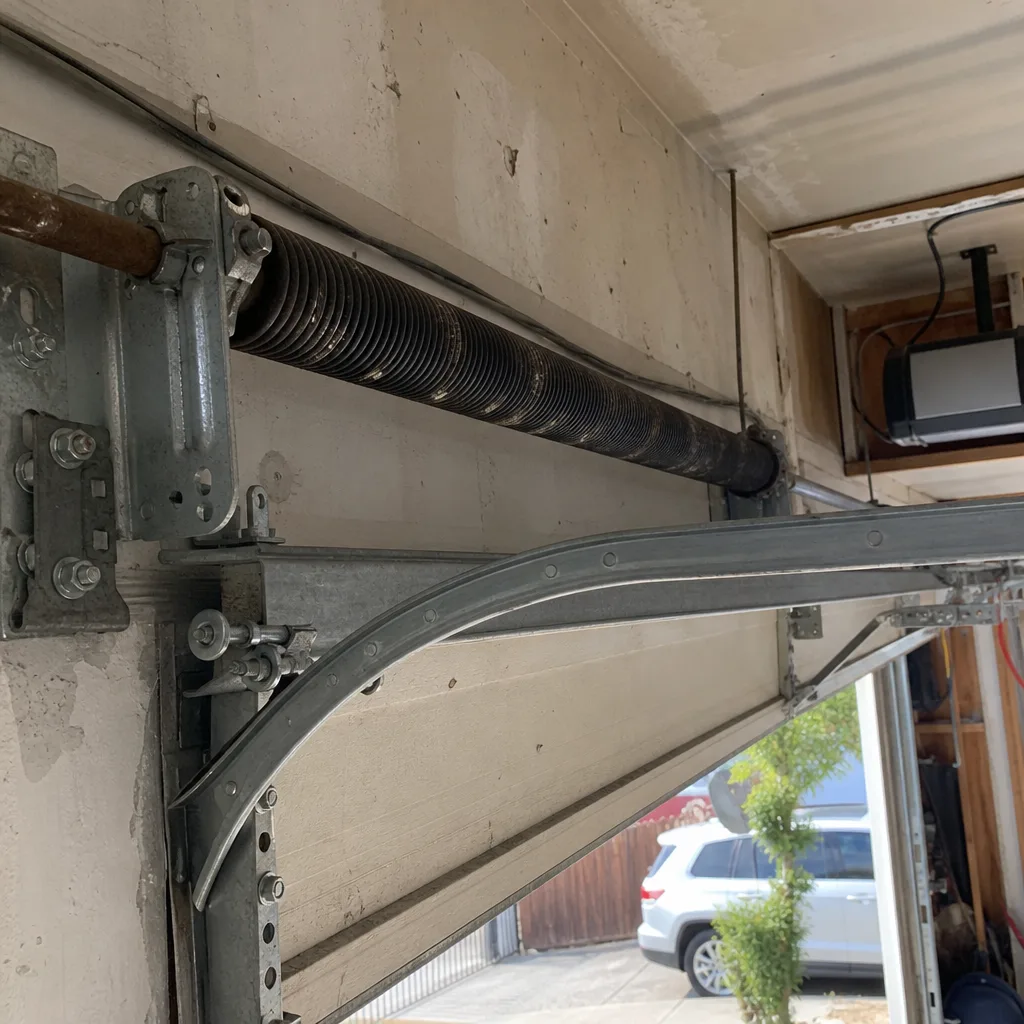 Before
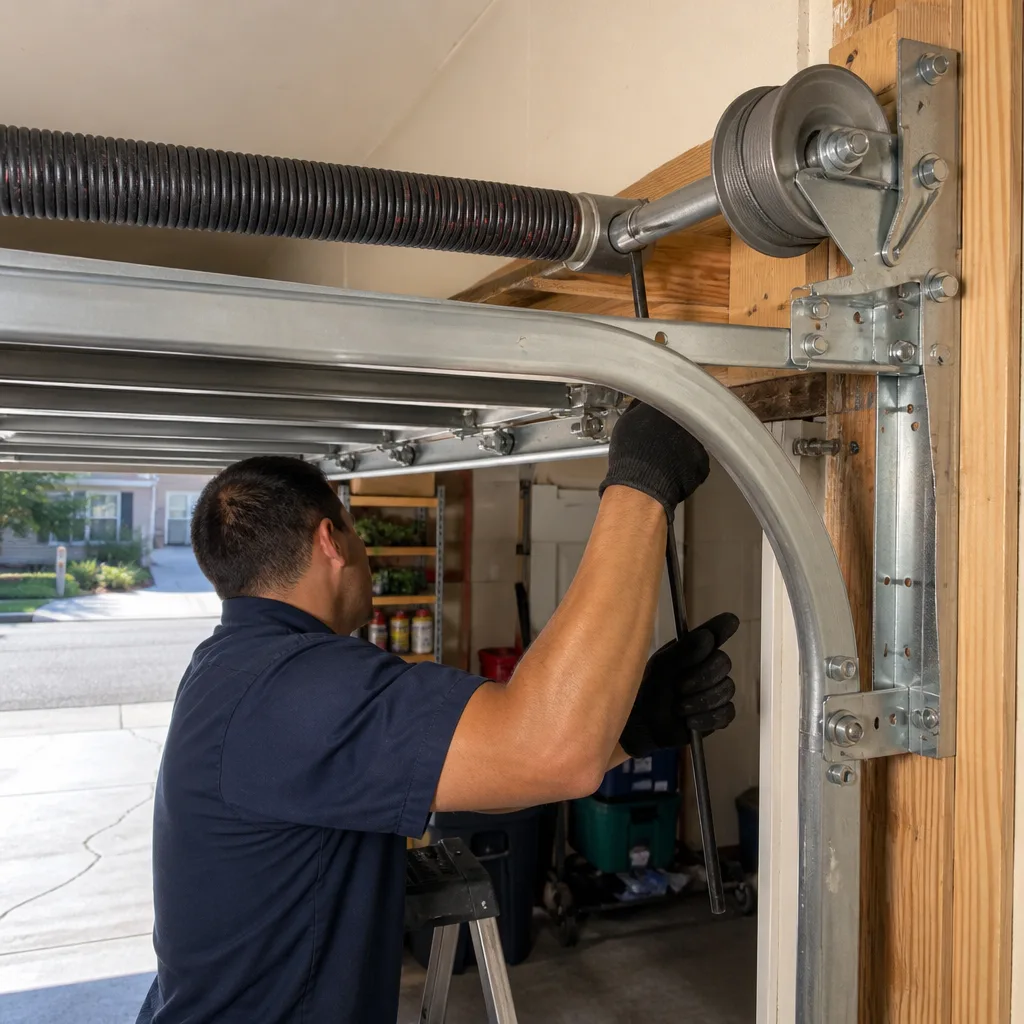 After
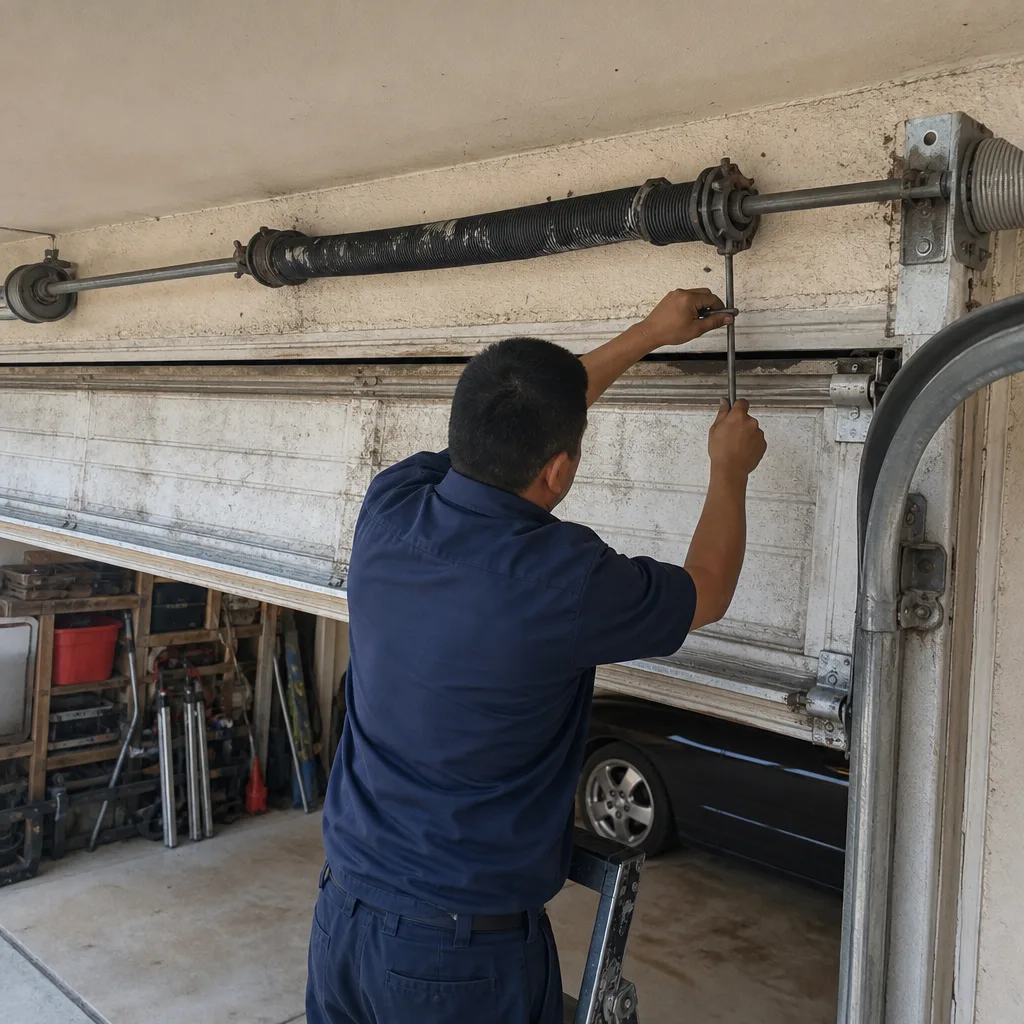 Before
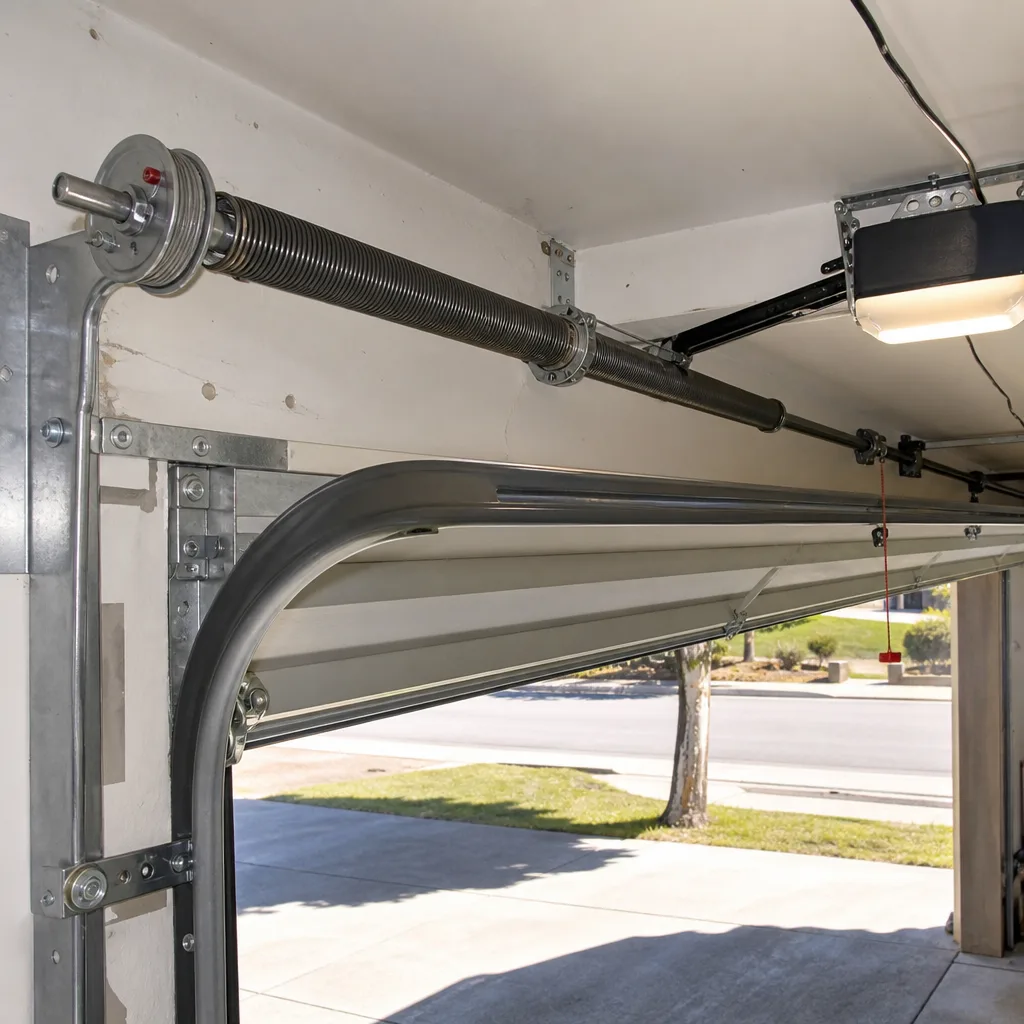 After
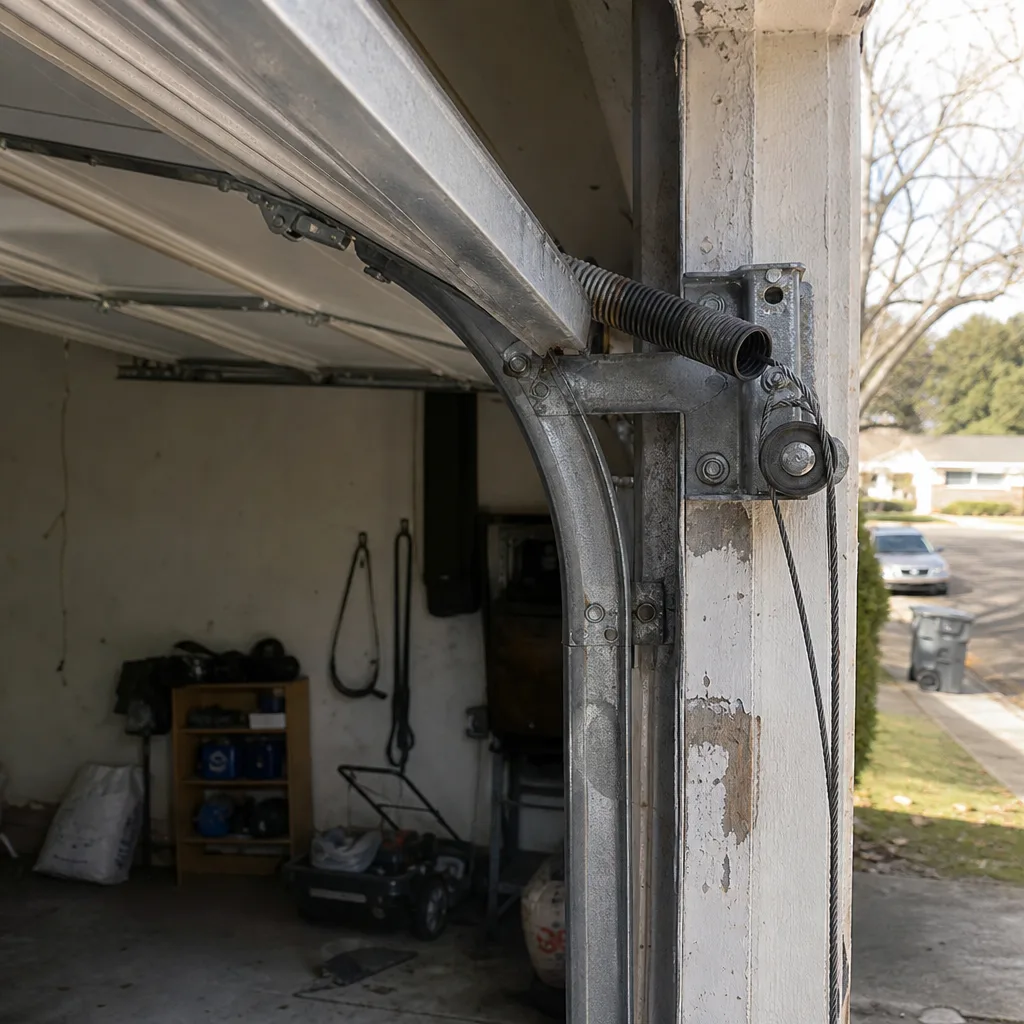 Before
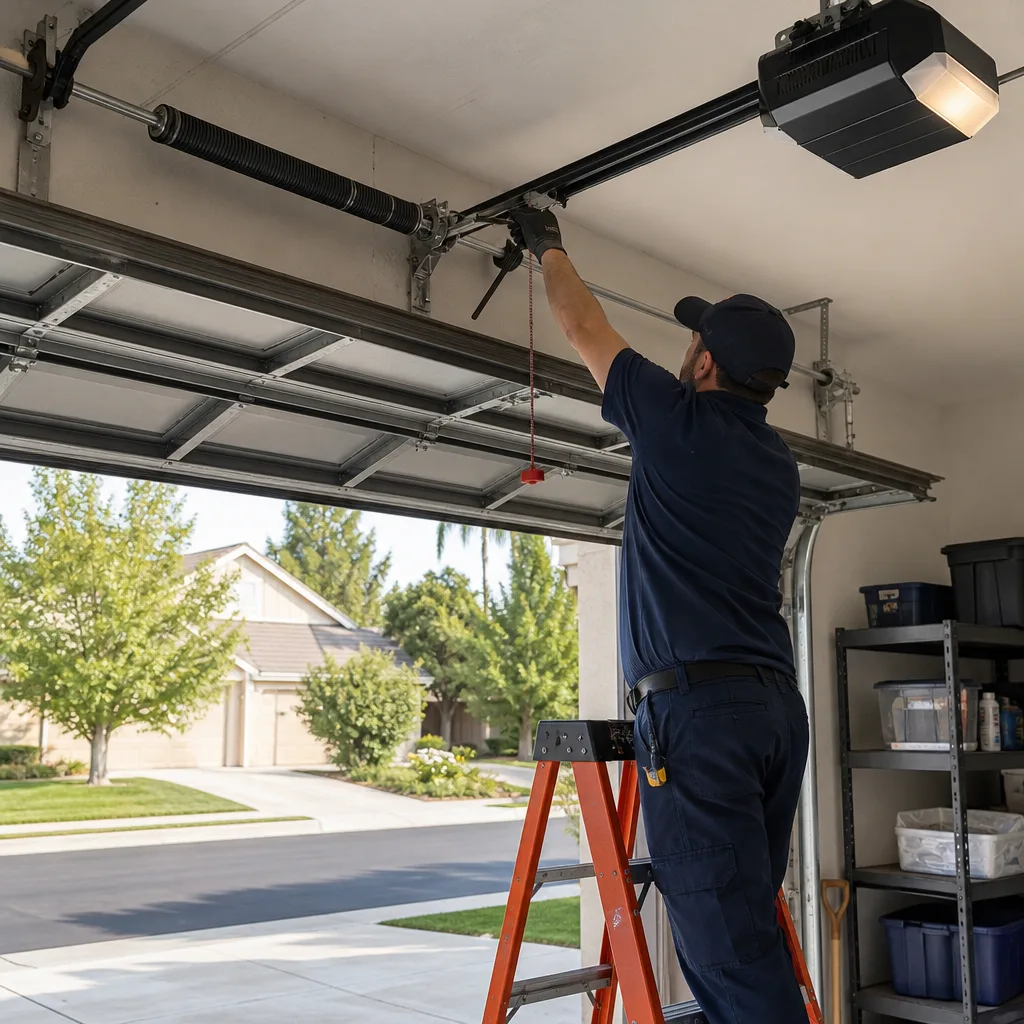 After
When to Call a Professional
Call a specialist immediately if your door: (1) made a loud cracking noise and now won’t lift; (2) lifts unevenly or sits crooked in the opening; (3) produces a grinding or screeching sound that wasn’t there a week ago; (4) starts down and immediately reverses, and you’ve already checked the sensor alignment; or (5) the opener motor runs but the door doesn’t move. Each of these is a mechanical or electrical failure that gets worse with continued use. You should also call if you have an older Elk Grove home with extension springs and you’re not sure whether safety cables are installed – the check takes a specialist five minutes and could prevent a serious injury. Artisan Garage Door Repair offers free estimates in Elk Grove – call (855) 631-8980 and describe what you’re seeing. You’ll get a straight answer about whether it needs a visit or whether it’s something you can handle yourself.
Frequently Asked Questions
Most garage door repairs in Elk Grove run between $180 and $450, depending on whether you’re dealing with a broken spring, a snapped cable, or a failed opener board. The diagnostic fee alone is typically $40 to $80, and reputable shops apply that toward the repair if you proceed. Call (855) 631-8980 for an exact quote for your specific door and opener – estimates are free.
Yes, in most cases. Spring replacements, cable repairs, and sensor realignments are typically done same-day or next-day in Elk Grove, depending on your neighborhood and the part required. The fastest way to get a same-day slot is to call early and describe the symptom accurately – (855) 631-8980.
Look at the wall-mounted control panel or the motor housing itself – the brand name is stamped directly on the unit. LiftMaster and Chamberlain are the most common brands in Elk Grove, with Genie common in older homes. If you don’t see a name, call us and we’ll help you identify it from the unit’s shape and button layout.
Yes. Torsion springs are under enough tension to lift a 150 to 300 pound door, and when they release that energy suddenly – which happens during careless DIY attempts – the result is often a serious injury. This is one repair that should always be left to a trained specialist. If your spring has snapped, keep the door closed, stay clear of the spring, and call a professional.
No. Mechanical repairs to existing garage doors – including springs, cables, rollers, openers, and hardware – do not require a city permit. A full structural door replacement may trigger permit review in certain circumstances, particularly for attached garages with living space above. Check with the City before a complete replacement.
No. We quote the repair price based on what we can see and describe before work starts, and that’s the price you pay. If a hidden problem is discovered during the repair, we stop and call you with the updated number before continuing. No surprise invoices. Call (855) 631-8980 to get a quote for your door.
The Bottom Line
Elk Grove garage doors fail in predictable ways, driven by our valley climate and the specific housing eras that shaped our neighborhoods. Valley heat cycles torsion springs into early retirement. Dust from open fields grinds down rollers and hinges. And the 1990s-era openers in so many Elk Grove homes are now at the end of their service life. Understanding what your house likely has, what’s safe to fix yourself, and what demands a specialist will save you money and injuries. From a stuck spring to a full new installation, one call covers it. And the call is (855) 631-8980.
Written by the team at Artisan Garage Door Repair, serving Elk Grove since 2014.